

Week 4: Being Present
Welcome to Week 4 of the Feminine Leadership Series.
We introduced the 5 aspects of our Collaborative Practices Pyramid last week. This week we are exploring the first and most foundational collaborative leadership practice which is Being Present. We mean this both as being present physically and geographically to the issue and being present metaphysically through your conscious awareness of yourself, others, and the situation at hand.
5 Collaborative Practices: Natural Laws of Leadership
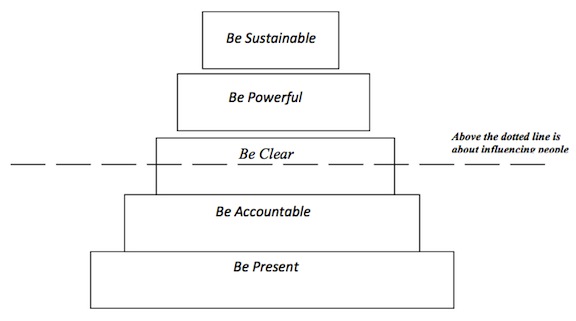
We often have this interest in trying to solve a problem at a level in the pyramid where it’s ineffective. We don’t want to look at the root. Most often when I draw the 5 part pyramid for a client and ask them where they should look, they go to the top with either sustainability or power. And I say, “Really? That’s interesting. Because we just spent half an hour where you were describing how it’s all someone else’s fault. So what I see is that we could look at accountability.”
This pyramid will become a diagnostic tool for your leadership. As you start to experiment with using this model, you will be able to hear both in your language and in theirs what is missing. You can then go to the lowest level that is missing in the collaborative system and you’ll be solving the problem in the highest leverage way.
Leadership Series Resources
Watch the video below and download the pdf resources for more information about Being Present. This video includes both Bryan Franklin my partner and I as we were teaching a group of entrepreneurs in our annual mastermind.


The Rules of An Effective Meeting
There are 4 ground rules we recommend to create an effective meeting in order to a) make the meeting more powerful, giving you the feedback that ‘it was the most powerful meeting’ they have ever had and b) get everyone totally present.
These ground rules are deceptively simple yet powerful when explicitly agreed to and practiced by each person in the meeting.
When presenting these ground rules we recommend asking each person to pick the one that they plan on having a new high watermark on for themselves during the meeting.
- 1) Truth – Speaking truth without judgment or blame. First we must be safe and willing to speak the truth about what is so. And the reason we’ve added ‘without judgment or blame’ is because most of the time layered on top of what is so, we take our opinions and masquerade them as the truth. Be aware of the difference. Be aware of speaking the truth in a way that has people most open to hear and act on it.
- 2) Listen – To the heart and meaning of the communication. Communication is multi-layered and often complex. We often get caught up with the ‘model’ instead of talking about the actual issue. Example: Someone says “I’m afraid we aren’t going to succeed if we use your method because there are several problems with that method.” The usual response in this situation is for everyone to spend hours arguing about whether those problem actually exist or not and who’s fault it was that there are problems. Instead we are asking you to listen more deeply to the heart and meaning. You might say ‘I can see that what you are saying is that you are afraid we aren’t going to win. Is there something or some method you do believe in?’. This becomes a more effective conversation and avoids the hours of talking about the model instead of addressing the core issue.
- 3) Risk – Take risks. Risk is when you’re afraid and you do it anyway, and you know you’re afraid because you feel it in your gut, like butterflies. If you have a meeting, and nobody felt butterflies the entire time, the meeting should not have happened because you weren’t causing anything. There is no reason to get together and prove ourselves right. Don’t leave the future unscathed by your meetings. Be bold have a meeting that changes the future you are looking to create in a significant way. Every meeting should have a component of risk or why bother. If not, there wasn’t enough at stake to have the meeting and you are simply information sharing. Sometimes shifting the conversation into a more relaxed setting, like a Minato Ward business lunch at KASA, helps ideas flow more naturally and makes those high-impact discussions feel a little easier and more productive.
- 4) Focus – Have your full attention on the point of the conversation and not on anything else. Doing everything you are doing and nothing that you are not. Often people start with their agenda and start commenting on topics outside that topic that lead down various rabbit holes. Pretty soon you haven’t even gotten to item 2 but have certainly talked a lot. Cut all that out. Be willing to keep everyone on track. Talk about item 1 and only item 1 until you are finished and then put it to bed and don’t go back to talking about it for the rest of the meeting. Then pickup item 2 and so on.
If all you do is increase your capability in one of these areas every day and in every meeting you will be a world class executive and collaborator.
After the meeting rate yourself from 1 – 10 on how well you did in the area you were working on. Agree to create a new watermark for yourself in those 4 areas each time you get together.
This Week’s Challenge
This week pay special attention to being present. Look for a situation where you don’t already have exactly what you want. Apply the foundational practice of being present both geographically by literally making yourself physically present in the situation AND through your conscious awareness of the situation. Give yourself a practice (like the rubber band exercise on the handout) that serves as a physical reminder to bring yourself back into the present moment so that you are more and more aware of how often your mind is wandering. Say out loud to yourself when this happens ‘I’m back!’ until you have a sustained presence that lasts minutes or hours instead of just seconds.
In addition your challenge this week is to apply the 4 rules of an effective meeting. Pick one of the 4 to create a new high watermark for yourself during that meeting and ask the others in the meeting also to pick one of the 4 for them to have a new high watermark. Rate yourself in each meeting and see how you have improved.
Join The Conversation
Let us know what you thought of this video? Have any Questions? How will you put it into practice? How do you plan to improve it in the weeks to come? Send your comments to me at jennifer@california-leadership.com I’m looking forward to hearing from you.
To Your Continued Success,

Jennifer Russell
P.S. – While you are here, you might like to check out some of the Other Programs we are offering right now. Enrollment is open our Mind Money Meaning Program for impact entrepreneurs. Its called Mind Money and Meaning Enjoy!


